“Why have I come to this world?”
In his book Jaiva-Dharma, His Divine Grace Srila Bhaktivinoda Thakura Maharaja, asks this question, why have I come to this world?. And, he says, “the day that the jīva first asks this question is the auspicious day his good fortune arises.”
Few questions are as profound as this one. It marks the beginning of a person's search for the truth of existence.
In Śrīmad Bhagavad-gītā, the living entity, jīva, is described as an eternal entity and a part and parcel of the Supreme Personality of Godhead, Kṛṣṇa (BG 15.7). It is also stated that once the jīva enters the spiritual sky, vaikuṇṭha, he never returns to the material world (BG 8.15, BG 15.6). The very fact that we are here, therefore, suggests that we were never in vaikuṇṭha.
Then, where was I before I entered this material world?
Before attempting to answer this question, let us first understand who we, the jīvas, are.
The Supreme Personality of Godhead, Kṛṣṇa, the cause of all causes, possesses three primary energies: internal energy (antaḥ-ṣakti), external energy (bāhya-ṣakti), and marginal energy (taṭsta-ṣakti). His internal energy is also known as cit-ṣakti, the spiritual energy, and is His superior energy. His external energy is called māyā-ṣakti (māyā), the material energy, and is His inferior energy. His marginal energy is known as jīva-ṣakti, which is superior to māyā.
The living entity belongs to this marginal energy and is, by nature, a pure spirit. The Lord is cit, and the living entity is cit-kaṇa, an atomic spirit, just as a spark is an atomic particle of fire. The Lord is the master of māyā, whereas the jīva can come under the influence of māyā.
The jīvas exist in two states: the liberated state (mukta-daśā) and the state of material bondage (saṁsāra-baddha-daśā). Those who reside in the spiritual world are eternally liberated. They remain forever engaged in the loving service of their worshipable Lord, firmly situated in their constitutional position as eternal servants of Kṛṣṇa. Liberation simply means freedom from the influence of māyā.
Thus, the constitutional position of the jīva is to be the eternal servant of īśvara, the Supreme Controller of everything that exists, Kṛṣṇa.
Yet the living entity is endowed with independence. This is Kṛṣṇa’s special mercy upon the jīva. It is this independence that distinguishes conscious life from inert matter. When we voluntarily surrender this independence at the lotus feet of Kṛṣṇa, we become liberated even while physically situated in the material world. Being marginal, the living entity, although pure spirit by nature, can still be influenced by the Lord’s bewildering inferior energy, māyā.
How, then, did the living entity first enter the material world?
The jīva’s first location is on the boundary between the spiritual world and the material world.
According to His Divine Grace Srila Bhaktivinoda Thakura Maharaj, among the liberated beings, some reside eternally in Goloka Vṛndāvana, the topmost abode of the spiritual world, lovingly serving the Supreme Personality of Godhead, Kṛṣṇa. Others reside in the various Vaikuṇṭha planets within the spiritual world, serving the Lord of Vaikuṇṭha, Śrī Nārāyaṇa. Still others, who are not fully liberated, enter the material world.
But how?
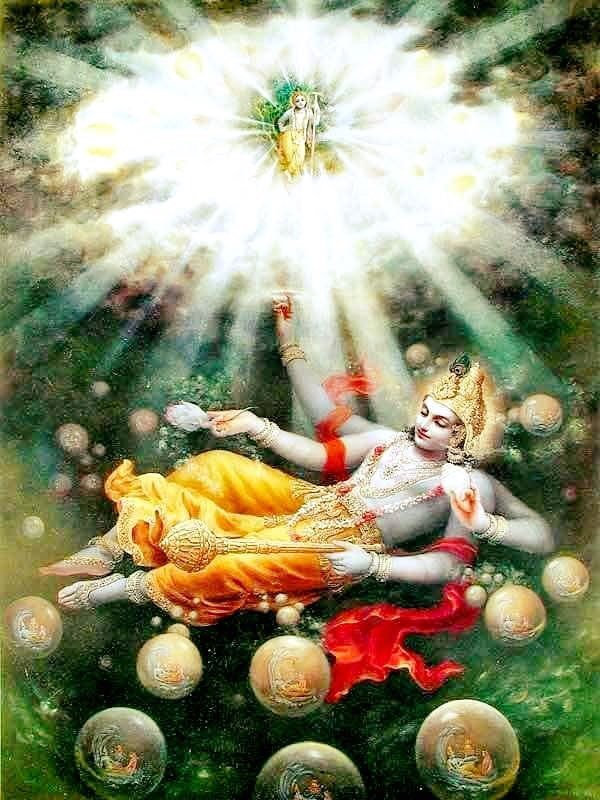
The spiritual world and the material world are separated by the Causal Ocean, called the virajā river. Kāraṇodakaśāyī Māhā-Viṣṇu, a partial manifestation of Kṛṣṇa, situates Himself upon the Causal Ocean. From there, He casts His glance upon māyā, who is situated far away. By that glance, the material world becomes agitated, or activated.
In Śrīmad Bhagavad-gītā (9.10), Kṛṣṇa Himself describes how the material world (prakṛti) comes into being:
mayādhyakṣeṇa prakṛtiḥ
sūyate sa-carācaram
“Under My superintendence, My illusory energy creates the universe full of moving and non-moving beings.”
The atomic conscious jīvas emanate as rays within Kāraṇodakaśāyī Māhā-Viṣṇu’s glance upon His māyā-śakti. Situated on the taţ, the bank of the virajā river, they witness the wonderful workings of māyā. At times they look toward the spiritual world, and at other times toward the material world.
In this marginal condition, the jīva is exceedingly weak because he has not yet attained the spiritual strength required to properly exercise his independence. When the jīva uses that independence correctly, he remains inclined toward Kṛṣṇa. When he misuses it, however, he becomes indifferent to Him. It is this very indifference that awakens within the jīva the desire to enjoy māyā.
Then, how can the jīva return home, back to Godhead?
When the jīva enters material existence, he assumes a new type of egoism. In his pure state, the jīva identifies himself as an eternal servant of Kṛṣṇa. In the conditioned state, however, countless forms of egoism arise, causing the living entity to think, “I am a father,” “I am a wife,” “I am a president,” “I am a scientist.”
These attitudes are known as ahaṁtā, which literally means the sense of ‘I-ness,’ or false egoism.
Along with ahaṁtā arises another function known as mamatā—possessiveness, or the sense of ‘my-ness.’ Thus the living entity begins to think, “this is my house,” “this is my country,” “this is my family,” and “this is my knowledge.”
Material existence means identifying with these qualities of ‘I-ness’ (ahaṁtā) and ‘My-ness’ (mamatā).
Yet I-ness and My-ness also exist in the liberated state, in the spiritual world. There they are real, eternal, and perfectly situated, existing solely for the pleasure of serving the Supreme Personality of Godhead, Kṛṣṇa. In material existence, however, they are merely imposed upon the living entity. Being temporary, they bring only fleeting happiness and inevitable distress.
However, by sādhu-saṅga, the association of devotees, and prapatti, surrender, the jīva can once again realize his eternal constitutional position.
We find the following statement about sādhu-saṅga in Śrīmad-Bhāgavatam (11.2.30):
ata ātyantikaṁ kṣemaṁ
pṛcchāmo bhavato ’naghāḥ
saṁsāre ’smin kṣaṇārdho ’pi
sat-saṅgaḥ śevadhir nṛṇām
“O sinless one, we are inquiring from you about the supreme benefit. In this material world, even half a moment’s association with a śuddha-bhakta is the greatest wealth for human beings.”
In Śrīmad-Bhāgavatam 10.48.31, Kṛṣṇa Himself describes the importance of sādhu-saṅga:
darśanād eva sādhavaḥ
“No one can deny that there are holy places with sacred rivers, or that the demigods appear in deity forms made of earth and stone. But these purify the soul only after a long time, whereas saintly persons purify just by being seen.”
Prapatti is described in Bhagavad-gītā (7.14)
daivī hy eṣā guṇa-mayī
mama māyā duratyayā
mām eva ye prapadyante
māyām etāṁ taranti te
“This divine energy of Mine, consisting of the three modes of material nature, is difficult to overcome. But those who have surrendered unto Me can easily cross beyond it.”
All glories to Sri Gurudeva. All glories to Srila A. C. Bhaktivedanta Swami Prabhupāda. All glories to Srila Bhaktivinoda Thakura Maharaj.
(Disclaimer: The subjects discussed in this article do not represent my personal opinions. They are authentic explanations presented in detail by His Divine Grace Srila Bhaktivinoda Thakura Maharaj in his monumental literary work Jaiva-Dharma, the contents of which I have drawn upon extensively in writing this article. Accordingly, all credit for the philosophical content and its exposition belongs to Srila Bhaktivinoda Thakura Maharaj.)